I’ve been thinking about what AI is actually going to do to how we work—not in the hype-cycle sense, but in the practical, lived, day-to-day reality sense. Not “AI will replace all jobs” or “AI will make everyone 10x”, but something more subtle and, I think, more disruptive.
The short version: I don’t agree with the common sentiment that AI will replace X or Y.
I think it will cause a rift, a tectonic division of plates that were once fused to form a cohesive Gaussian distribution landmass.
But first, this diversion to background context…
The Triangle We’ve Always Lived With
There’s this well-known triangle in consulting. Or at least, I see it all the time in consulting: Fast, cheap, or high quality. You only ever get to pick two.
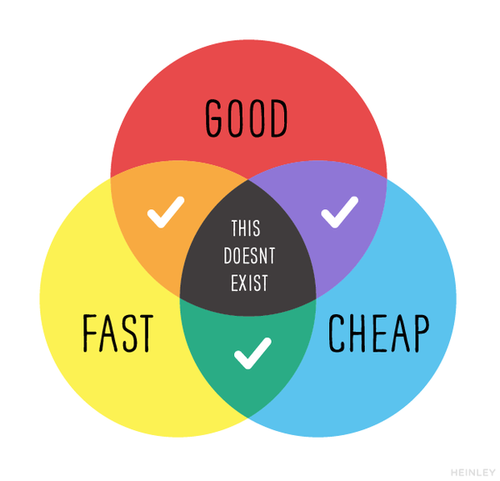
If you want it fast and cheap, quality suffers. If you want it cheap and high quality, it takes time. If you want it fast and high quality, it won’t be cheap.
Historically, most work settles into the middle of two circles. Not fast, not slow. Not cheap, not expensive. Not bad, not exceptional. Just… acceptable. Middle-speed. Middle-cost. Middle-quality. Unless you explicitly optimize or subsidize one side, you get…middling. Exceptions include the space shuttle (heavily subsidized for fast), whatever the Vatican owns (soooooo not cheap), and Q Branch for James Bond.
AI Breaks that Center of the Distribution
Instead of most work clustering around the middle, we’re going to see a divergence. One end pushes toward very fast, very cheap, lower-quality work. The other end pushes toward very slow, very expensive, extremely high-quality work.
I predict that the middle, the average, the generalist, “good enough” output will start to disappear due to the sheer speed of repetition, and the repetition of the masses.
AI is trained on the corpus of human knowledge. And human knowledge, when you look at it statistically (and self referentially), is overwhelmingly average.
AI works the same way. It excels at producing the center of the distribution—best practices, common patterns, typical solutions, established conventions. Most codebases, processes, and operational knowledge live here simply by the fact that most projects, most development, and most human output balances numerous real-world factors (time, money, skills) and rarely over indexes on any one factor.
And now, with that quality of work rapidly reproducible, it becomes devalued.
But the best work won’t.
High-end work—true excellence—is rare. It’s contextual. Situational. Nuanced. And usually less constrained in some way. It breaks common rules designed for common constraints.
I saw a breakdown recently of the cinematography in Sicario, focusing on lighting, framing, blocking, and movement. There are rules for almost every type of mood, aesthetic, and scenario that one can conceive of. After all, visual storytelling is almost as old as our species. The analysis in the video itself was incredible—but what stood out was the choices made, and how well they contradicted the common rules in order to produce outstanding effects.
An example: in Western cultures, visual motion typically flows left-to-right and top to bottom, like how we read. It’s ingrained in us. In a pivotal scene, a group of soldiers moves across screen from left to right, descending into pre-dawn twilight. The scene creates unease and quite literally shows a descent of archetypal good into darkness. The choice was deliberate, layered, and aligned with the film’s moral descent.
That kind of expertise demonstrated in that scene (and the move overall) is incredibly rare: in this case, it’s the work of the renowned Roger Deakins. It’s bespoke. And it’s hard for AI to replicate because it doesn’t show up often enough in the training data.
The Best Won’t Compete With AI—They’ll Extend Themselves With It
This is where things get interesting.
The best coders, designers, presenters, strategists—the people who already operate at the high end, are the Roger Deakins of their craft. And as such, they aren’t threatened by AI. They’re amplified by its ability to provide commonality at speed. They can use it to extend their creative breathing room. Get the repetitive stuff done faster to spend more time and money on paradigm breaking.