Author: skp_admin

  • The Second Divide: Who Benefits Most From AI

    The Second Divide: Who Benefits Most From AI

    Continuing off of the last discussion around ‘The Death of Mid’…

    There’s another split forming, and it has less to do with the divide in quality of work and more to do with a division in how people think. It’s a random musing of thoughts, but bear with me.

    AI works best when problems are decomposed, steps are explicit, sequences are clear, and constraints are articulated. This kind of thinking—process thinking, decomposition, sequential reasoning—has traditionally been strongest in engineering, architecture, and systems design.

    What we started to see in mid 2025 with Claude Code agents / skills / subagents and will see much more in 2026 are people who already think this way translating ideas into structured steps, feeding them into AI, and dramatically accelerating their output. Case in point: Cursed – a Gen Z programming language from the mind of Geoffrey Huntley.

    So What’s Your Point?

    Let’s take the opposite end of the spectrum:

    AI struggles with ambiguity, emotional nuance, and situation-specific judgment. You can’t write a universal, step-by-step playbook for great sales without drowning it in caveats.

    However—if someone can decompose their own expertise—how they build trust, how they read a room, how they sequence conversations, how they adjust based on signals—then AI can amplify that.

    The Pattern Beneath Everything

    This all points to a deeper truth about expertise. Mastery isn’t magic.

    It’s the ability to do something badly, then do it acceptably, then do it well, then understand why it works, and finally know when to break it and create something new. In martial arts, it’s known as Shu-Ha-Ri (roughly translated to “obey”, “digress”, “separate”)

    AI is phenomenal at the Shu. But humans still dominate Ha and Ri: understanding why something works and knowing when to break the rules to create something innovative and original.

    The future of work won’t belong to people who fight AI—or people who blindly rely on it. It will belong to those who understand their craft deeply enough to translate itdecompose it, and extend it.

    It’s the end of the middle, the death of Mid, and the beginning of something sharper.

    Note of full disclosure: I wrote most of this using Wispr and Notion’s internal writing AI refinement tools. The words are my own, proofread and edited thoughts from a human (me), by a human (also me), with an AI meddling in the middle (supervised and berated, by me).

  • The Death of ‘Mid’

    The Death of ‘Mid’

    I’ve been thinking about what AI is actually going to do to how we work—not in the hype-cycle sense, but in the practical, lived, day-to-day reality sense. Not “AI will replace all jobs” or “AI will make everyone 10x”, but something more subtle and, I think, more disruptive.

    The short version: I don’t agree with the common sentiment that AI will replace X or Y.

    I think it will cause a rift, a tectonic division of plates that were once fused to form a cohesive Gaussian distribution landmass.

    But first, this diversion to background context…

    The Triangle We’ve Always Lived With

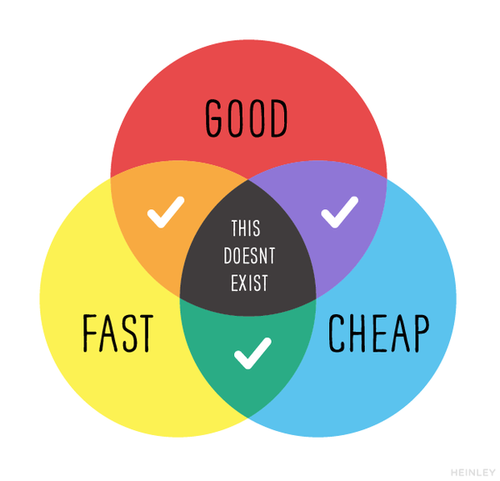
    There’s this well-known triangle in consulting. Or at least, I see it all the time in consulting: Fast, cheap, or high quality. You only ever get to pick two.

    If you want it fast and cheap, quality suffers. If you want it cheap and high quality, it takes time. If you want it fast and high quality, it won’t be cheap.

    Historically, most work settles into the middle of two circles. Not fast, not slow. Not cheap, not expensive. Not bad, not exceptional. Just… acceptable. Middle-speed. Middle-cost. Middle-quality. Unless you explicitly optimize or subsidize one side, you get…middling. Exceptions include the space shuttle (heavily subsidized for fast), whatever the Vatican owns (soooooo not cheap), and Q Branch for James Bond.

    AI Breaks that Center of the Distribution

    Instead of most work clustering around the middle, we’re going to see a divergence. One end pushes toward very fast, very cheap, lower-quality work. The other end pushes toward very slow, very expensive, extremely high-quality work.

    I predict that the middle, the average, the generalist, “good enough” output will start to disappear due to the sheer speed of repetition, and the repetition of the masses.

    AI is trained on the corpus of human knowledge. And human knowledge, when you look at it statistically (and self referentially), is overwhelmingly average.

    AI works the same way. It excels at producing the center of the distribution—best practices, common patterns, typical solutions, established conventions. Most codebases, processes, and operational knowledge live here simply by the fact that most projects, most development, and most human output balances numerous real-world factors (time, money, skills) and rarely over indexes on any one factor.

    And now, with that quality of work rapidly reproducible, it becomes devalued.

    But the best work won’t.

    High-end work—true excellence—is rare. It’s contextual. Situational. Nuanced. And usually less constrained in some way. It breaks common rules designed for common constraints.

    I saw a breakdown recently of the cinematography in Sicario, focusing on lighting, framing, blocking, and movement. There are rules for almost every type of mood, aesthetic, and scenario that one can conceive of. After all, visual storytelling is almost as old as our species. The analysis in the video itself was incredible—but what stood out was the choices made, and how well they contradicted the common rules in order to produce outstanding effects.

    An example: in Western cultures, visual motion typically flows left-to-right and top to bottom, like how we read. It’s ingrained in us. In a pivotal scene, a group of soldiers moves across screen from left to right, descending into pre-dawn twilight. The scene creates unease and quite literally shows a descent of archetypal good into darkness. The choice was deliberate, layered, and aligned with the film’s moral descent.

    That kind of expertise demonstrated in that scene (and the move overall) is incredibly rare: in this case, it’s the work of the renowned Roger Deakins. It’s bespoke. And it’s hard for AI to replicate because it doesn’t show up often enough in the training data.

    The Best Won’t Compete With AI—They’ll Extend Themselves With It

    This is where things get interesting.

    The best coders, designers, presenters, strategists—the people who already operate at the high end, are the Roger Deakins of their craft. And as such, they aren’t threatened by AI. They’re amplified by its ability to provide commonality at speed. They can use it to extend their creative breathing room. Get the repetitive stuff done faster to spend more time and money on paradigm breaking.

  • It comes back to reading…

    It comes back to reading…

    I’ve been building this weekend. It felt really good. Mostly just exploring some ideas in Replit, Codex, and Claude. Yes, I’ve been using all three. There are some overlaps, some distinct quirks, and some ease of use aspects. I am by no means an expert in any of the tools, and so most of this exploration in how to break an idea down, and utilize their respective capabilities to benefit my aims. One of the obvious conclusions I’ve learned is that not everything is an app.

    Yeah, totally obvious. For someone who has almost no formal technical background, it’s a groundbreaking level of understanding. And while this could turn into an indictment of every “hello world” tutorial I’ve done and then subsequently quit, there were some truly simple levels of understanding that came together in the moments of playing around with the various agents. I started to see the pros and cons of deterministic vs nondeterministic code. I started to understand where a Python or Bash script could be more useful than Javascript with a slick UI.

    And then the technology starts to become clearer. Where there’s hype – AI will NOT solve everything and it definitely has downsides. And where it’s just like other technologies – it will change the way we work – in some of the ways we assume and some that we don’t see coming. It feels a lot like cars. Horses weren’t outright replaced (try driving the Grand Canyon) and cars weren’t perfect overnight: here, the infrastructure piece is critical. AI will need roads…and given how much is being spent on data centers and the like, maybe we’ll see a bicycle effect: because roads exist, biking becomes more adoptable.

    So maybe there’s a question there: what’s the equivalent of biking when it comes to all this new technology? Something cheap, efficient, mildly counterculture but also sustainable and human?

  • not quite a technical thing…

    not quite a technical thing…

    This is NOT an AI post…well, it sort of is…but not entirely.

    I’ve been wrestling with an idea over the past few months.

    With the steady advancement of AI, people are able to build more with less.

    Significantly more.

    Like, solo devs outputting multiple complete consumer ready applications in days. What formerly would take multiple teams (designers, project managers, devs, release managers, architects, and more) is now…Ralph Wiggum.

    While I’m amazed and awe-inspired, something else akin to a feeling has been lurking and lunging at the surface of my consciousness in various forms. And like a Covid era sourdough that hath finally risen, I think I’ve identified it as this:

    There is going to be a revolution in tech culture.

    The next evolution of the tech bro is going to be the tech redneck and the gingham collar worker.

    Let’s backtrack on how I got here.

    First, was from an experiment of my own to build my daughter a garden.

    I, an overly ambitious Type A with trust issues, decided to build an concrete patio extension that wrapped around a 16’x10′ box garden where we could plant marigolds and strawberries and I could instill the wonders of nature on an impressionable mind and maybe perpetuate the mythos of ‘Superdad’ for just one more year please before all the inevitable eye rolling and sarcasm and uncoolness.

    With ChatGPT, it actually fucking worked. I mean, it’s not level, and there are some interesting “gaps for proper drainage”…but my handyman father-in-law said ‘hey, that’s actually pretty good.’

    Next, were a smattering of ‘Personal AI Assistant’ YouTube videos.

    I went down a rabbit hole – where enterprising developers built out elaborate systems for writing, research, and tech builds in domains removed from their expertise. My favorite is KAI from Daniel Miessler.

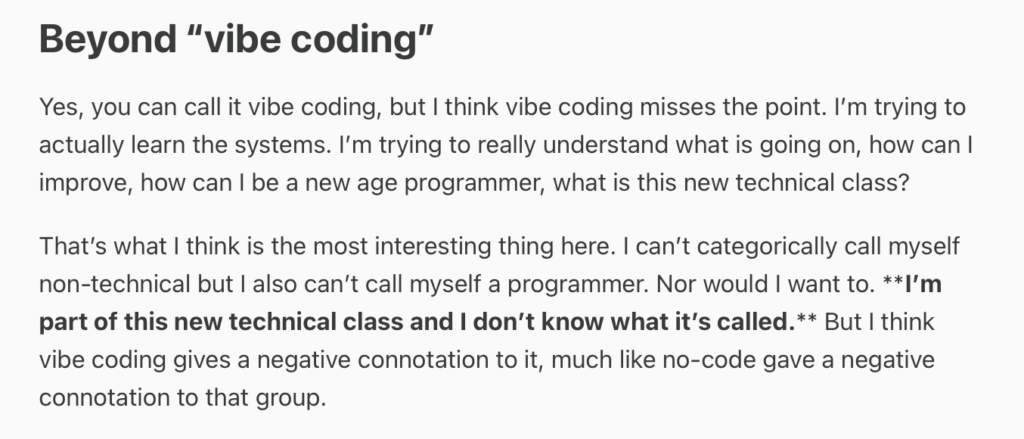
    And finally, on Sunday, this comment from Ben Tossell of Ben’s Bites (phenomenal newsletter, do subscribe) where he describes a ‘new technical class’:

    Prior to the advent of AI tooling, the breadth and requirements of most jobs forced workers into a niche that could typically be defined as blue collar or white collar jobs.

    Even more modern advents like pink collar (nursing and other care related professions) and gray collar (EMS, pilots, law enforcement, military) are still defined by a narrow professional set of skills and capacities with a resume that stays within the ‘collar’ boundaries. Nurse resumes have nursing education and jobs, pilot resumes are filled with…planes, architect portfolios have architecture (conceptual and real world).

    To remain employable, relevant, valuable you had to continuously add to your resume or portfolio, showcasing your ever increasing command of the professional niche. A surgeon who codes has way too much free time and I’m immediately suspicious of their surgical skills…and their code.

    AI can now erase those barriers.

    In other words, that same surgeon can leverage Claude Code to build a SaaS app for surgeons…and actually work well enough for other surgeons to adopt.

    Extrapolate this further: what formerly separated two distinct worlds: office / knowledge work vs manual/trades work can no longer defend its moats and boundaries. The initial activation energy in the form of time and learning and practice is now, in both tech and trade, minimized. There’s no shortcut to expertise and mastery, but amateur personalization? Just a few prompts and requirements elicitations away.

    It’s not just tech bros like myself who can jump into landscaping, or home maintenance, or woodworking projects.

    The converse is accessible too. Work a trade service such as plumbing, HVAC, or contract remodeling? Want to implement a custom project planner, pre-work renderings, and payment processing + invoicing? Claude, OpenAI, Gemini, and Replit will build for you, bespoke to you.

    Is it going to be perfect or enterprise grade? Not yet. But it will get there. The key pieces of accessibility and understandability are in place. And with that bridge built and paved, AI has connected formerly separated worlds that had to be navigated via niche focused companies with SaaS platforms account executives who stuffed contracts with SLAs and expensive add-ons. But no more at the smaller scales.

    The innovators will cross over. They’ll tinker, abandon, start over, tweak, and build…IRL to PROD.

    And let’s also be honest: at first, it will lead to a lot of half-completed, semi-abandoned, projects dotting many an AI generated portfolio page (I’m a card carrying member). And plenty of GitHub repos and YouTube tutorials that people copy, riff, and modify.

    Actually, we have a precedent for this in the US: affectionately, the redneck. The one with all the half completed projects dotting the lawn, garage, or basement alongside one or two phenomenally showcased completed builds.

    I expect to see a lot of these one-off, semi completed, profession-crossing projects surface in 2026. It’ll lead to some salacious YouTube comments, arbitrary huffing, puffing, and gatekeeping, and definitely some valiant no true Scotsman-ing.

    But the collars will blend.

    And the ranks will swell.

    Proud tech rednecks with gingham collars.

    We must welcome everyone.

    I am excited.
  • this ‘AI’ thing…

    this ‘AI’ thing…

    Wow, second post and he’s already talking about AI. Throw in some crypto and a little day trading and we’ll hit the tech bro trifecta.

    I agree: it’s an overplayed topic foisted upon all of us and I’m not here to change that. That said, let’s acknowledge a few things:

    • It’s here and accessible
    • It’s a powerful technology with a new operating paradigm
    • Like all technology, it’s neither good nor bad. It just amplifies the human condition

    With that, I want my shot at it: there’s never been a more accessible revolution since the advent of fire (cue infomercial: with just a flint and some wood, YOU can be the hottest caveman on the planet).

    You don’t need university time (early computers), a brownstone and money to pay for labor (early electricity), or a military clearance (microwave and radio communication). With the first world blessings of an internet connection and access to a computing device (smartphone, tablet, laptop, desktop), you can access AI.

    I’ll also point out how long science fiction has been waiting for this. See Packy’s amazing SciFi Idea Bank built with AI from the incredible work of Technovelgy.

    So why are we so annoyed with this thing?

    Strong opinion here: probably because we keep building dumb irrelevant shit no individual cares about or benefits from.

    Companies definitely care about it: Marketing optimization, ROI maximization, CRM insights and automation, VC valuations, media manipulation.

    But us mortals in our daily lives? Not really. It doesn’t save me money, give me more time, reduce my stress, or bring a guiltless smile to my face (see: Ghiblification).

    But, can it?

    Last year, I built a story generator with pictures and choose your own characters for my daughter so I could read to her about turtles and friendships even when I was traveling. (She loved it. For a week, I felt like the Dad I always wanted to be)

    I made a small workout tracker that reminded me to get up every hour and complete a few reps. It totaled the calories and gave me progressions for exercises I wanted to get better at. (I hate pull-ups so much).

    I journaled a lot more and learned about my emotional and social habits: good and bad. (in December, Anno Domini 2025, I used “no” as a full sentence in a professional context)

    Yes, I could have done all of these without AI. But it would have taken significantly longer and cost quite a bit more in time, stress, and money. I’m not a web developer, a personal trainer, or a therapist. Neither is AI. I am someone who can set a goal and break down the steps and put in a reasonable effort tailored to my strengths and weaknesses.

    That’s what I like about this AI thing. That’s what I’m going to do more of this year.

  • this thing…called ‘Exposure’

    this thing…called ‘Exposure’

    I have a great boss.

    I’ve only had one or two in my entire working adult life, and my current one is definitely one of the best.

    In the manner of great bosses (technically she’s my ‘people leader’), she is wildly proficient at her work, empathetic, calming, and a grounded leader who cares about her people doing the best work they can.

    A week ago, she posted this in our team chat:

    A Fresh Start

    Question: What’s one word or intention you want to carry into the new year?

    An older version of me would have found the question hokey, or too ‘feelingsy’ to respond to. But this is what a good leader does: makes you want to participate.

    So I gave it a go and responded:

    Exposure

    During my career, I’ve strived to be the ‘quiet professional’ and ‘a servant leader’ letting my work ‘speak for itself.’ I’ve doubled down on hard work assuming a good team, a good manager, a good company would notice and advocate for me. Deliver value, receive value. And when it didn’t pan out as I wanted, I’ve switched roles, jobs, and companies.

    It worked really well. Until it stopped.

    This past year has been hell and it’s not going to be over for a while.

    I’d driven myself at top speed into a wall. Mentally, emotionally, somewhat physically. And I noticed. The accolades and rewards I wasn’t earning. The friends I wasn’t making. The opportunities that stayed just out of reach.

    I am constantly striving to learn, grow, and accomplish more. I am incredibly capable. But if it’s all invisible, then it is the proverbial tree falling in the unwatched forest.

    So this site, This Thing, is my exposure. To start with a whisper.

    My thought processes, my writings, my experiments.